
Protect Your Car from Hail – The Best Measures Against Hail Damage
By Gennadij Tscherepanow · Dent removal expert · 22 April 2024
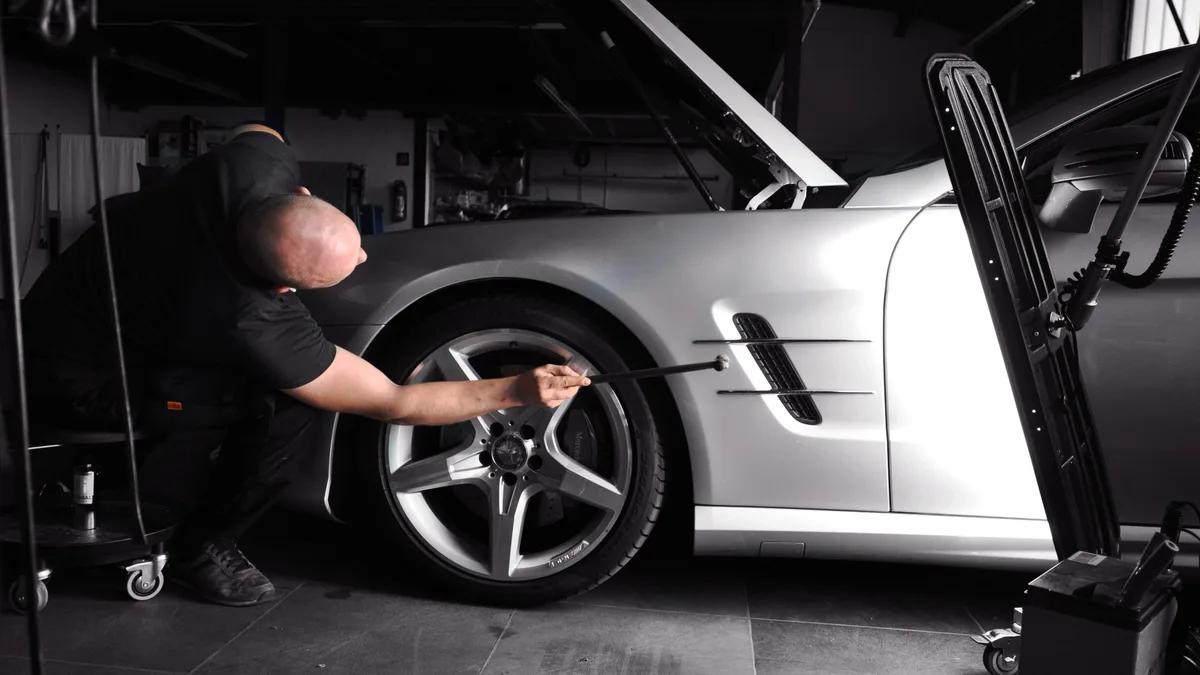
How to protect your car from hail effectively – and what really helps if hail damage has already happened: hail dents can usually be repaired without repainting.
Anyone wanting to protect their car from hail essentially has three levers: a solid roof over the vehicle (garage or carport), a genuine hail protection cover for when you are out and about, and enough lead time thanks to a good severe-weather app. That is the honest short answer – sadly, there is no hundred-percent protection out on the open road. That is exactly why every precaution needs a plan B: should hail damage occur anyway, hail dents can in the vast majority of cases be fully removed using PDR, without filler and without repainting. In this guide we show you step by step what really works.
Is there even noteworthy hail in Germany?
Yes – and more than many people assume. Baden-Württemberg in particular is one of the most hail-prone regions in Germany, and in the Backnang and Stuttgart area strong thunderstorms with hail pass through regularly during the warm months. The hail season typically runs from late spring into late summer, when warm, humid air meets thunderstorm cells. Even marble-sized hailstones are enough to leave widespread damage with dozens of dents on the roof, bonnet and boot lid.
The best measure: a solid roof over the car
The most effective way to protect your car from hail is and remains parking under a solid roof. A closed garage offers the best protection – not only against hail, but also against storms, falling branches and UV exposure. A carport is a very good alternative, as long as the roof is stable and large enough; make sure the sides also offer some protection against hail falling at an angle. Anyone without their own garage can often switch to public car parks or underground garages during forecast storms – which, in case of doubt, is the cheapest insurance there is.

A real hail cover instead of an improvised fix
If no garage is within reach, a dedicated hail protection cover is the second-best solution. Such covers are built up in several layers and fitted with padded foam or air cushions that absorb the energy of the hailstones. What matters is a well-fitting, securely fastened cover that does not slip or flap even in wind. A genuine hail cover does not replace a garage, but it noticeably reduces the damage in a hailstorm – provided it is fitted in good time.
Why improvised blankets help very little
The temptation is great to throw old wool blankets, camping mats or cardboard onto the car at the last moment. Honestly, that usually achieves little: thin blankets have hardly any cushioning, slip in the storm and soak up water, becoming heavy and useless. Large hailstones punch straight through them. An improvised solution can make a small difference in an emergency, but it is no substitute for a real hail cover – and certainly not for a solid roof.
Gaining lead time: weather and severe-weather apps
The best cover is useless if the storm catches you by surprise. That is why every smartphone should have a reliable severe-weather app, ideally with push notifications and a real-time rain radar. This way you can see hours in advance whether a thunderstorm cell is heading towards Backnang or Stuttgart, and you can move your car into the garage or car park in good time. Activate location-based warnings and, during hail season, take a quick look at the forecast each morning – those two minutes will save you a lot of trouble when it counts.
The right behaviour during hail season
During the hail-prone months it pays to plan parking more deliberately: if you have the choice, put the car under a roof rather than out in the open. If a storm catches you while driving, calmly and with foresight look for shelter such as a petrol-station canopy, a car park or a bridge – but only if this is possible safely and without risky manoeuvres. Do not stop under individual trees, as branches may break off there. Your own safety always comes before the bodywork.
Plan B: if hail damage has happened anyway
Despite all caution, hail cannot always be avoided – but that is no reason to panic. The good news: hail dents are the textbook case for paintless dent repair, that is, dent removal without repainting. They are usually round, without a sharp core, and spread across large surfaces such as the roof, bonnet and boot – exactly the ideal field for PDR. The technician uses special tools to push the metal back into its original shape from the inside in a controlled way, entirely without filler and without repainting. The original paint is fully preserved in the process.
Why PDR works so well on hail dents
Behind the method lies simple physics: metal deforms either elastically and springs back, or plastically and stays deformed – and it is precisely this plastic deformation that the technician brings back in a controlled way. As long as the metal is not stretched or torn and the paint is intact, this usually succeeds without a trace. On aluminium parts the metal is gently warmed so that it becomes more pliable, because aluminium hardens quickly when deformed. A light hail damage on a car with many small dents is therefore almost always a classic case for PDR – and the final assessment is made personally by our expert.
A dent or hail damage on your car?
Just send a photo — the master inspects your car personally and calls back with an honest assessment. Within 2 hours, Mon–Fri 10–16. No automatic price.
Where the limits of PDR lie
As versatile as PDR is, there are clear limits, and we are honest about them. If the paint is cracked or has flaked off, if the dent sits right at the panel edge or on a flange, or if it involves high-strength structural parts, dent removal without repainting reaches its limits. In some cases the technician can pre-form the dent so far that any subsequent painting is minimal and as much original substance as possible is preserved. Old filler areas or built-in sensors and radar technology (driver assistance systems) are also factors that the master checks beforehand.
Advantages of PDR for hail damage
PDR has several genuine advantages when it comes to hail damage. Because the original paint is preserved, there is no repaint in the vehicle's history – which noticeably protects its residual and resale value. The repair usually takes hours rather than days, and it is environmentally friendly because no paints or solvents are needed. Especially with widespread hail damage involving many dents, PDR often saves the entire vehicle from being written off as a total economic loss.
Insurance and hail damage – briefly explained
Hail damage is the classic case for partial comprehensive (Teilkasko) cover and is usually settled without a downgrade, meaning your no-claims bonus stays intact. Insurers work with tables and expert reports that record the number and size of dents per component. Report the damage promptly and ask your insurer about the deadline. Online calculators provide rough estimates at best – a reliable assessment is only possible on the vehicle itself.
How best to proceed now
So take precautions while the weather is calm: keep a garage or car park in mind, have a real hail cover at the ready and arm your severe-weather app. And if it does catch you out, you do not have to face the hail damage alone. Simply send us a photo of your vehicle – our expert will assess your dents personally and get back to you with an honest evaluation, with no online calculator and no flat-rate price. You can usually expect a callback within two hours, Monday to Friday between 10 a.m. and 4 p.m.
FAQ
What really helps against hail on a car?
Most effective is a solid roof – garage, carport or car park. When out and about, a genuine, securely fastened hail cover helps, combined with a severe-weather app that warns you in good time. Improvised wool blankets, on the other hand, achieve very little.
Is there even hail in Germany?
Yes, and sometimes heavily. Baden-Württemberg is one of the most hail-prone regions, including around Backnang and Stuttgart. The hail season runs from late spring into late summer, when thunderstorms with hail frequently pass through.
Can light hail damage on a car be repaired without repainting?
In the vast majority of cases, yes. Light hail damage with many small, round dents is the ideal case for PDR – the metal is pushed out from the inside and the original paint is preserved. The condition is that the paint is intact; the final assessment is made by the expert.
Does insurance cover hail damage?
Hail damage is the classic partial comprehensive (Teilkasko) case and is usually settled without a downgrade, so your no-claims bonus remains intact. Report the damage promptly and ask your insurer about the deadline.
Is an ordinary blanket enough as hail protection?
Only to a very limited extent. Thin wool blankets or cardboard barely cushion, slip in the storm and soak up water. Larger hailstones punch through them. A dedicated, multi-layer hail cover protects considerably better – but a solid roof remains the first choice.
How much does hail damage repair cost?
There is no flat answer, because every hail damage is different – the number, size and location of the dents decide. That is why we have no online calculator and no flat-rate price. Send us a photo and the expert will assess your dents personally and get back to you with an honest evaluation.