
How to Remove a Dent From Your Car? Home Remedies & the Pro, Honestly Reviewed
By Gennadij Tscherepanow · Dent removal expert · 5 April 2022
An honest look at the DIY tricks going around: when hot water, a hair dryer or a suction cup might actually pop out a small dent, what the risks are and when only the pro will do.
Short and honest up front: removing a dent from your car with home remedies can occasionally work – but only with very small, shallow dents that have no sharp crease and completely intact paint. In the vast majority of cases the DIY method is either useless or downright risky. If you want to play it safe, have the dent removed professionally using the paint-friendly pushing technique (PDR). In this guide we explain the popular tricks, tell you openly when they work and when they don't – and what to watch out for before you take matters into your own hands.
How to remove a dent: first understand what happens to the metal
Body panels deform in two ways: elastically (they spring back on their own) or plastically (they stay deformed). A dent you can see is plastically deformed – the metal has been pushed past its springback limit. The goal of any repair is to bring that metal back into its original shape in a controlled way. The decisive factor is that the paint must not be cracked and the metal must not be overstretched. If the paint is intact, the odds are good; if it is cracked or the metal is kinked, it gets difficult – no matter which method you use.
Removing a dent with hot water – when it can work
The internet classic: pour boiling water over the dent so the material softens and becomes pliable, then push it out from the inside. This can indeed occasionally work on flexible plastic bumpers and on very small, shallow metal dents without a sharp core. The heat makes the paint temporarily more stretchable. The risk: boiling water can damage the clear coat, widen existing fine paint cracks and cause scalds if it splashes. On deeper or angular dents, removing a dent with hot water usually achieves nothing.
Hair dryer and cold: the temperature-shock trick
The idea: heat the dent with a hair dryer (or hot air) and immediately cool it sharply with a freeze spray or compressed air. The rapid expansion and contraction is supposed to make the metal spring back. On tiny, round dents in thin metal this can occasionally show an effect. Caution is needed: too much heat dulls the paint or makes it blister, and an abrupt temperature shock can stress brittle or old paint. Nothing is guaranteed here – often the dent simply stays where it is.
Suction cup and glue puller: pulling instead of pushing
A strong suction cup or a simple glue-pulling kit from the hardware store attaches to the outside and pulls the dent forward. On round, shallow dents without a sharp edge on an easily accessible surface – such as a door – this is the DIY method with the most realistic chance of success. It is gentler on the paint than heat because no temperatures are involved. The limits: pulling too hard can create a so-called overstretch (high spot), a bulge pointing outward that is harder to correct than the original dent. On body lines, edges and creases the suction cup almost never works.
Removing dents with a magnet: a stubborn myth
The topic of removing dents with a magnet keeps coming up – the idea that a strong magnet pulls the metal smooth. In practice it does not work: a magnet does not transfer enough targeted pulling force to bring a plastically deformed spot back to its original contour, and it gives you no control over the shape whatsoever. On top of that, modern bodies are partly made of aluminium, which a magnet has no effect on at all. Save yourself the attempt – at best it achieves nothing, at worst it adds scratches.
The hidden danger: aluminium and aged paint
Many DIY tricks assume the metal behaves cooperatively. Aluminium does not: it has almost no springback, hardens quickly when deformed (work hardening) and becomes brittle in the process. That is why professionals heat aluminium in a controlled way to around 80 to 100 degrees so that metal and paint become more pliable – without that control, aluminium cracks quickly. Old, oxidised or previously repainted paint also tolerates little stretching and is more likely to flake. This is exactly where the biggest risk of doing it yourself lies: a small dent turns into paint damage that then becomes genuinely expensive.
Which dents can be professionally pushed out well?
The professional, paint-friendly pushing technique (PDR, also called dent removal without repainting) is made exactly for the cases where home remedies fail. Hail dents – round, numerous, on the roof, bonnet and boot lid – are the ideal field of application. Parking dents and door-edge dents (the typical door dings), as well as broad dents without a sharp core, can usually be reshaped cleanly, often even on body lines. An intact paint surface is always the prerequisite. The big advantage: the original paint is preserved, no filler is involved, and the value of your vehicle is maintained.
A dent or hail damage on your car?
Just send a photo — the master inspects your car personally and calls back with an honest assessment. Within 2 hours, Mon–Fri 10–16. No automatic price.
When even the pro cannot avoid repainting
Honest stays honest: not every dent is a case for pure pushing technique. Dents right at the panel edge or on seams, sharp kinks and folds, visible paint cracks, old filler spots or areas with sensors and radar technology (driver assistance) exceed the limits of the paint-free method. High-strength structural parts also do not belong in amateur hands. In some cases the master pre-shapes the dent so far that the painter only needs minimal finishing – this saves filler and preserves the substance. Which path is the right one is only decided after a professional assessment.
A short history: why PDR exists at all
The idea of reshaping metal without repainting is surprisingly old. As early as 1931 Frank T. Sargent systematised straightening technique in his work on metal bumping. The modern method emerged in the 1950s and 1960s at Mercedes-Benz; the inventor is considered to be Oskar Flaig, who in 1960 at a trade fair in New York pushed out display dents overnight with a hammer handle from the inside – without any repainting at all. This trick became internal training; from the late 1970s the technique spread in the USA and finally worldwide. Wooden handles became alloyed steel hooks, lighting systems and fine glue technology – the foundation of today's craft.
How a professional repair works
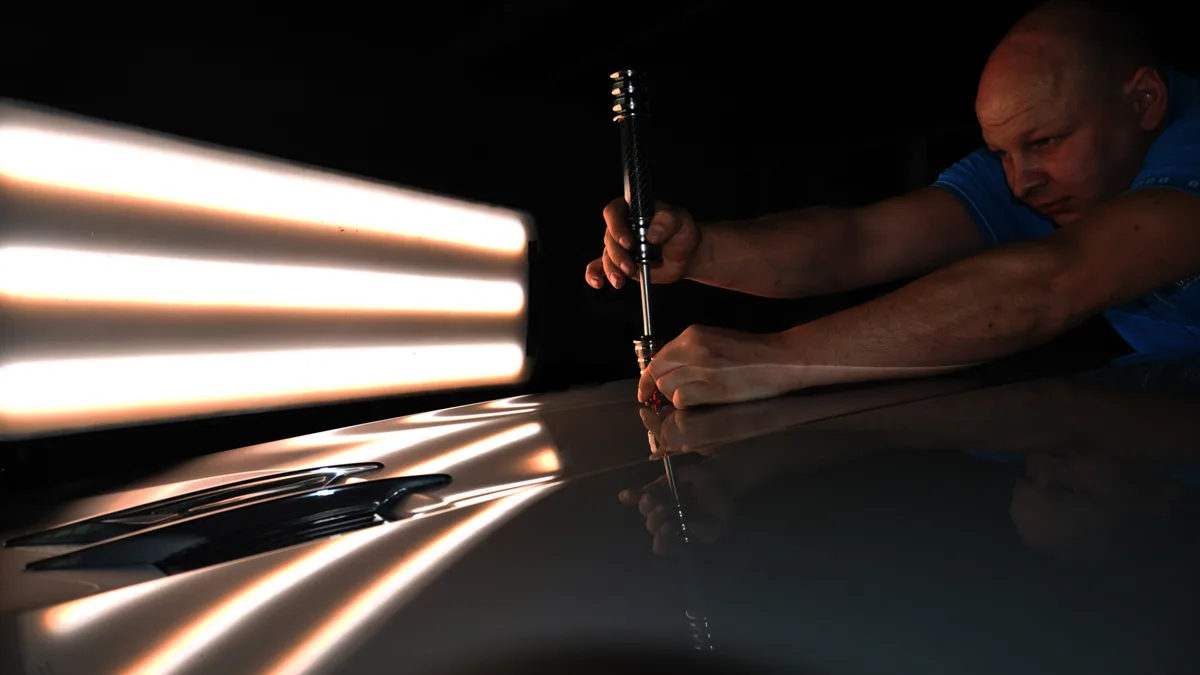
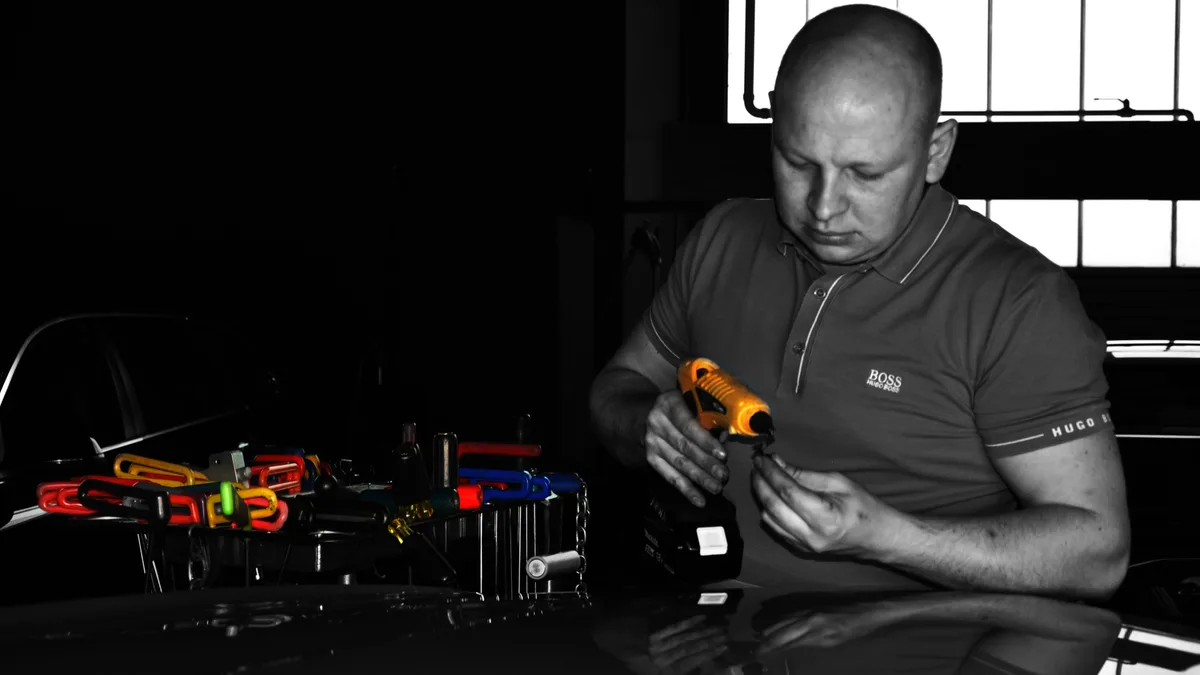
First the technician uses a light board to project straight reflection lines onto the metal – distorted lines reveal even the finest dent. Then he gains access through existing openings or by removing trim. With fine leverage tools he pushes the dent back millimetre by millimetre from the inside, or he works from the outside with glue adapters and a pulling lifter. Small tensions are carefully tapped down, and controlled heat helps with large distortions. The work is only finished when the light lines run dead straight again – that is the honest quality check. The whole thing often takes only hours instead of days and gets by without paints and solvents.
Removing a dent from your car: our honest recommendation
If you have a tiny, shallow dent without a kink on an open surface and the paint is absolutely intact, you may make a careful attempt with a suction cup – the lowest-risk method. For anything deeper, angular, near the edge or on aluminium, we advise against doing it yourself: the possible follow-up damage to the paint quickly outweighs the supposed saving. When in doubt, a simple rule applies: better to have it assessed by an expert once than to repair it twice. Simply send us a photo of your dent – our master will assess it personally and honestly and call you back within 2 hours (Mon–Fri, 10 am–4 pm) with a clear estimate. It costs you nothing but a brief moment.
FAQ
Can you remove dents yourself?
On very small, shallow dents without a kink and with intact paint, a careful attempt with a suction cup can succeed. On deeper, angular or edge-near dents and on aluminium, the risk of damaging the paint is high – then the professional pushing technique is the safe choice.
Which dents are easy to remove?
Round, broad dents without a sharp core on easily accessible surfaces are easiest to push out – typical parking and hail dents. Intact paint is always the prerequisite. Dents at edges, seams or with cracked paint are considerably more demanding.
What matters when choosing a workshop?
What matters is not the name of the workshop but the technician's experience with the paint-friendly pushing technique. Hail and parking dents in particular require a lot of craftsmanship and feel. As a specialist workshop for dent removal in the Backnang and Stuttgart region, our master assesses your dent personally and honestly.
What does it cost to have a small dent removed?
A blanket figure would be misleading, because every dent is different – size, location, depth and material type all matter. That is why we give no online price and no range. Send us a photo and the master will assess your dent personally and call you back with an honest estimate.
Does a magnet really help against dents?
No. A magnet provides neither enough targeted pulling force nor the necessary control over the shape to reshape a dent. On aluminium bodies it has no effect anyway. At best this trick achieves nothing, at worst it adds scratches.
Is hot water safe for the paint?
Only to a limited extent. Boiling water can stress the clear coat, enlarge existing fine cracks and cause scalds if it splashes. On flexible plastic bumpers the risk is lower than on metal with sensitive or aged paint. When in doubt, have it assessed by an expert.