
How Does Dent Repair Work? The Process & Tools Behind PDR
By Gennadij Tscherepanow · Dent removal expert · 19 October 2022
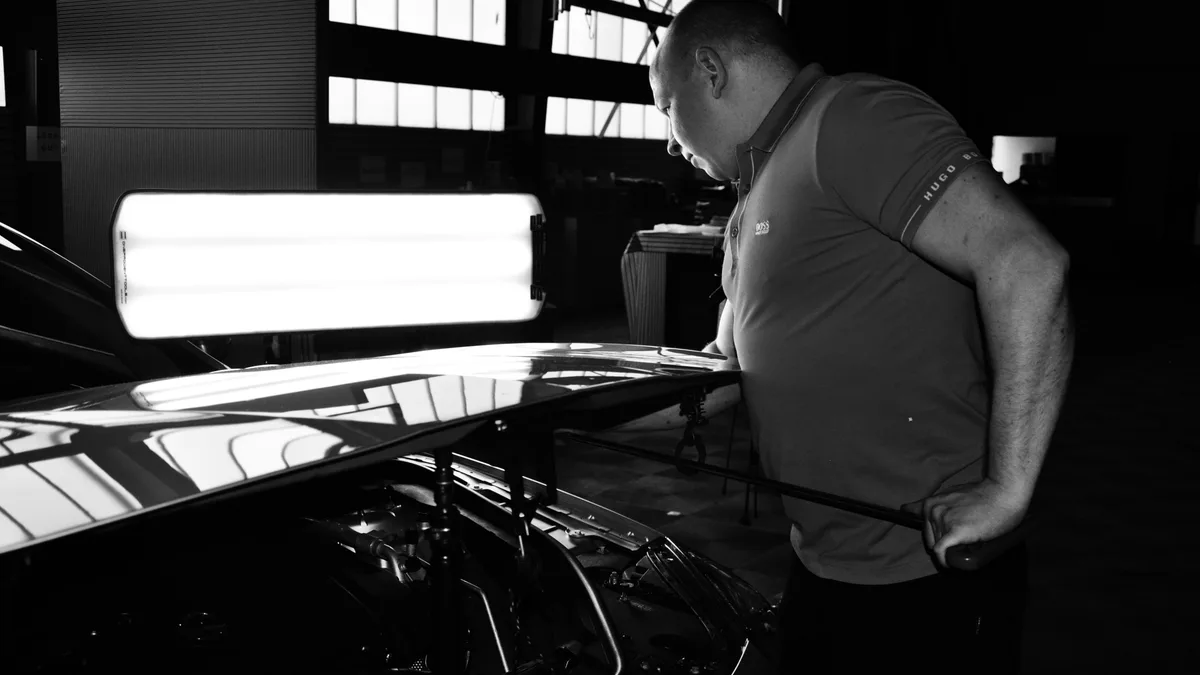
From the light board to the final touch: we show how a professional paintless dent repair really works and which tools the dent technician uses.
A professional paintless dent repair (PDR) follows clear steps: the dent technician makes the dent visible with a light board, gains access to the panel, pushes it back from the inside with rod tools or pulls it from the outside with glue technique, then releases the remaining tension with fine tapping and checks the result against the reflection lines. The original paint stays fully intact – no sanding, no filler, no respraying. In this guide we explain each step and the tools behind it, so you understand what really happens during dent removal.
What is PDR – and why does the paint stay intact?
PDR stands for Paintless Dent Repair. The basic idea is simple: metal deforms either elastically, springing back, or plastically, staying dented. A professional dent repair brings exactly that plastic deformation back into its original shape in a controlled way, without harming the paint surface. This works as long as the paint is intact and the panel is neither torn nor overstretched – the final assessment is always made by the master in person.
A bit of history: from a hammer handle to high-tech tools
The method's roots lie in classic body straightening, which Frank T. Sargent systematised as early as 1931. The modern version emerged in the 1950s and 60s at Mercedes-Benz: the inventor is considered to be Oskar Flaig, who in 1960 at a trade fair in New York pushed out show dents overnight from the inside with a hammer handle – entirely without respraying. From the late 1970s, PDR spread worldwide from the USA, and the tooling evolved from simple wooden handles to alloy steel rods, precise lighting systems and today's glue technique.

Step 1: making the dent visible – the light board
Before any work on the panel begins, the dent must be read precisely. To do this, the dent technician projects straight reflection lines onto the painted surface using a light board. Wherever the panel is distorted, these lines kink or bend – revealing depth, edges and the finest high spots that the naked eye often misses. Reading these light lines is the foundation of every clean repair and accompanies the technician throughout the entire process.
Step 2: gaining access to the panel
To reach a dent from the inside, the technician uses existing factory and seal openings or, if necessary, removes trim, lights or seals. This is exactly where experience shows: the right access path decides whether the rod tool can later reach the dent at the optimal angle. If inside access is impossible or too involved, the glue technique is used from the outside.
Step 3: rod tools – pushing the dent out from the inside
The heart of the method is the rod tools: alloy steel hooks in many lengths and curves. With them, the technician pushes and massages the panel millimetre by millimetre back into its original shape from the rear – every pressure point is checked immediately against the light lines. Pushing out a dent is never about force, but about feel, patience and precise dosing. Even a tiny overcorrection creates a high spot that has to be worked back again.
Step 4: glue pulling from the outside
When the panel cannot be reached from the inside, the glue technique comes in: special glue tabs are set onto the painted surface with hot melt glue, and the dent is gently pulled out with a pull lifter or slide hammer. This method is especially gentle because it requires no disassembly, and it complements rod work perfectly. The dent technician often combines both techniques on a single dent to achieve the best result.
Step 5: releasing tension and tapping
After pushing and pulling, small high spots – also called crowns – often remain. The technician gently taps these back down with Teflon knockdowns and fine tools until the surface is perfectly flat again. This releases the last tensions in the panel in a controlled way. This interplay of pushing, pulling and tapping is repeated until the material rests relaxed in its shape.
Step 6: induction and heat for large distortions
For large-area or stubborn distortions, controlled heat helps. With induction heat the panel can be warmed in a targeted way so it becomes more pliable and tensions are easier to work back. The right dosage is crucial: too much heat damages, too little achieves nothing. This is exactly where the routine of an experienced dent technician pays off, someone who has temperature and material behaviour in their feel.
A dent or hail damage on your car?
Just send a photo — the master inspects your car personally and calls back with an honest assessment. Within 2 hours, Mon–Fri 10–16. No automatic price.
Special case aluminium: why aluminium needs heat
More and more body parts are made of aluminium, and aluminium behaves fundamentally differently from steel. While steel has a natural spring-back force, aluminium lacks this almost entirely: it is tough, work-hardens quickly when deformed (cold working) and becomes brittle in the process. That is why aluminium is heated in a controlled way to around 80 to 100 degrees during dent removal, so that panel and paint become more pliable and do not crack. An aluminium dent demands considerably more experience, time and fingertip feel – and this assessment is exactly what the master takes on.
Step 7: fine finishing and final check
Finally, fine adjustments continue until the reflection lines on the light board run perfectly straight again and the factory structure of the panel matches exactly. Only when no trace of the dent is visible from any angle is the dent repair complete. The original paint has been fully preserved – no filler, no respraying and no visible marks in the vehicle's history.
Why it takes real experience
On paper the process sounds simple, but in practice every movement holds years of practice. The technician must read the dent three-dimensionally from the light lines, choose the right access and the right tool, dose pressure and heat precisely, and accurately judge the behaviour of both steel and aluminium. This combination of materials knowledge, tool mastery and patience is what makes a good dent technician – and the reason a reliable assessment always belongs in the master's hands.
The advantages at a glance
Because the original paint is preserved, PDR protects your vehicle's value: no filler and no respray appear in its history. The repair is usually done in hours rather than days and uses no paints, solvents or VOCs at all – so it is environmentally friendly. With hail damage the technique often saves the entire car from being written off, because many dents can be fixed at once.
FAQ
How long does it take to remove a dent?
It depends on size, location and material. A single parking dent is often fixed in well under an hour, while larger or awkwardly placed dents take longer, and aluminium needs extra heating time. Overall, a dent repair is usually a matter of hours, not days. The master will give you the exact time after seeing a photo.
How long does a dent doctor need for several dents?
With several dents, for example after hail, the effort per dent adds up, but a seasoned dent technician works very efficiently. Depending on number and size this can range from a few hours to one or two days. A reliable estimate is only given by the master after inspecting the vehicle.
What is a dent technician?
A dent technician is a specialist who removes body dents without repainting – using a light board, rod tools and glue technique. They read the dent from the reflection lines, dose pressure and heat precisely and know the different behaviour of steel and aluminium. It is a craft that demands a lot of experience and fingertip feel.
How much does a dent repair cost?
Dent repair costs cannot be quoted as a flat figure, because every dent is individual – size, depth, location and material all matter. We deliberately work without online calculators and without fixed prices. Simply send us a photo, then the master will assess your dent personally and call you back with an honest evaluation.
Does the original paint really stay intact during dent removal?
Yes – that is the decisive advantage of PDR. With proper dent removal the panel is reshaped without harming the paint, as long as it is undamaged. However, if the paint is already cracked or the panel overstretched, the method reaches its limits. The master makes this assessment reliably on site.
Can every dent be repaired without painting?
PDR works on most dents as long as the paint is intact – such as hail, parking and door-edge dents. If a single dent can be pushed out, the original paint stays intact. It gets difficult, however, with dents right at the panel edge, on flanges, on high-strength structural steel or sharp creases with cracked paint. Whether your dent is one of these is something the master can tell you after a quick look at the photo.